
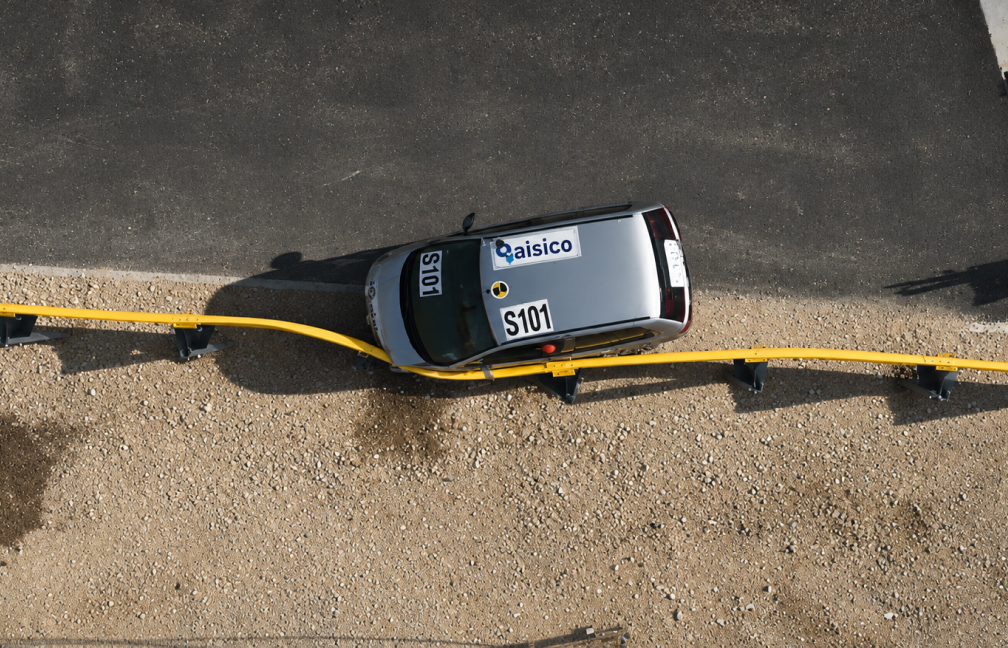
If you are considering a plastic guardrail for a road project, the first question your engineers will ask is whether it has been crash-tested to a recognized standard, by whom, and against which vehicles. A barrier that looks strong on a datasheet tells you little until a car has hit it under controlled conditions. This article sets out how the ASP polycarbonate guardrail was tested, what each test asked of it, and what the results mean when you compare it with steel.
AMP’s ASP polycarbonate guardrail has been crash-tested at Centro Prove AISICO in Italy to EN 1317 at the N1 containment level, with a 1,500 kg car at 80.4 km/h and 20.1°. It has also been tested for motorcyclist protection, passed China’s JTG B05-01-2013 Level A impacts and passed SGS weathering tests.
What Does the EN 1317 N1 Crash Test Ask of a Guardrail?
If your tender documents follow European practice, EN 1317-2 is the standard they will name. It sets the performance classes for safety barriers, and each class is defined by the crash tests a barrier must pass. The ASP guardrail was tested as an N1 barrier, the first of the two normal containment classes.
We are a plastic injection molder with plants in Taiwan and Thailand, making parts for automotive, electronics, appliance and other industrial customers. The ASP guardrail is our own product, designed and molded at our Taiwan plant, and we had it tested by two independent laboratories across three separate programs, with every report issued in our company name.
Our own quality and testing lab checks the material and the molded parts before they leave the plant.
The vehicle, speed and angle
If you compare test reports from different suppliers, look first at the test code. For N1, EN 1317-2 requires one test, called TB31. That test uses a 1,500 kg car striking the barrier at 80 km/h and an angle of 20°, as set out in the EN 1317-2 acceptance test tables published by SARTSMA, the South African road safety manufacturers’ association. In the AISICO test, the car struck the ASP guardrail at 80.4 km/h and 20.1°, which meets those conditions. To pass, the barrier has to contain the car and redirect it back towards the road. The car must not break through the barrier, roll over or be thrown back across the traffic lanes.
Where N1 fits among the containment classes
The next class up, N2, adds a 1,500 kg car at 110 km/h and a 900 kg car at 100 km/h. Which class a road needs is decided by the road authority in each country, usually by traffic speed, traffic volume and what lies beyond the barrier. If your project specifies N1, the ASP guardrail has the test evidence for it. If it specifies a higher class and you tell us at the start, we’ll say plainly whether the guardrail is suitable, so that you don’t find out at the approval stage.
Is a Polycarbonate Guardrail Safe for Motorcyclists?
If your roads carry many motorcycles, a car crash test answers only half your question. A rider who has fallen slides along the ground into the posts and the lower edge of the rail, and a standard vehicle test does not measure that risk. Separate tests exist for it, and AISICO tested the ASP guardrail to both of the main ones used in Europe.
CEN/TS 17342 and UNE 135900
The specification your tender is most likely to cite is CEN/TS 17342:2019, the European technical specification for systems that reduce the severity of impact for a rider who has fallen and slid into a safety barrier. UNE 135900:2017, published by the Spanish standards body UNE, is the Spanish national standard on the same subject. Few plastic barriers have been tested to either.
Why the material matters for riders
A struck steel rail can deform into a sharp edge (the ASP page sets out this risk in more detail), and a rider sliding into it meets that edge at speed. A polycarbonate rail flexes under impact and recovers its shape, and it has no exposed galvanized edges. If motorcyclist protection is part of your road safety brief, the performance class assigned under each standard is the figure your engineers should look for.
What China’s JTG B05-01-2013 Level A Test Involved
If you supply roads in China, or in markets that follow Chinese practice, JTG B05-01-2013 is the standard you will meet. It is China’s national standard for evaluating the safety performance of highway barriers, issued by the Ministry of Transport. The standard’s own text divides barriers into eight protection levels, each defined by the impact energy the barrier must absorb, and it requires full-scale impact tests with real vehicles.
We had the ASP guardrail tested to Level A by Beijing Shenhuada Traffic Engineering Test across three impacts (a 10-tonne truck, a 10-tonne bus and a car at 100.7 km/h), and it passed every evaluation item.
For you, the heavy vehicle tests are the most useful part of this program, since EN 1317 N1 does not include a truck or a bus. Together, the European and Chinese results show how the guardrail behaves under both a fast light vehicle and a slow heavy one.
| Test program | Laboratory | Impacts or conditions | Result |
|---|---|---|---|
| EN 1317-1 and EN 1317-2, N1 (TB31) | Centro Prove AISICO, Italy | 1,500 kg car at 80.4 km/h and 20.1° | Passed, N1 containment |
| CEN/TS 17342:2019 and UNE 135900:2017 | Centro Prove AISICO, Italy | Motorcyclist impact tests | Tested; class in the test reports |
| JTG B05-01-2013, Level A | Beijing Shenhuada Traffic Engineering Test | 10-tonne truck, 10-tonne bus, car at 100.7 km/h | Passed every evaluation item |
| Weathering | SGS | 1,000 and 1,500 hours | Passed |
How Does a Polycarbonate Guardrail Hold Up Outdoors and After an Impact?
If you are concerned about how plastic ages outdoors, the weathering results are the place to start, because a guardrail spends its whole life in the open and sunlight degrades most plastics first. The ASP guardrail has passed SGS weathering tests at 1,000 and 1,500 hours.
Color molded through the material
We mold the color into the polycarbonate using an automotive-grade UV pigment, rather than painting it on afterwards. There is no paint to fade or flake and no galvanized coating to renew, and a scratch shows the same color underneath.
You can specify the color to suit the road, and the directional reflector shows yellow to traffic traveling with the flow and red to traffic traveling against it.
After an impact
A steel rail that has been struck is usually dented and has to be replaced, which means a crew and lifting equipment on site. On our own figures, a polycarbonate rail absorbs the impact and recovers its shape, and maintenance costs about one-tenth of what a steel system needs. The guardrail has also been certified for use in Malaysia.
A 4 m part molded in one piece
We mold each ASP rail section as a single part, 4 m long, with a 6.8 mm wall and a 348 mm face, weighing 16.5 kg. Filling a mold of that length evenly, holding the wall thickness along it, and keeping the part straight as it cools are the same problems that come up in large automotive and industrial parts. Our article on large part injection molding covers those problems in more depth, and the guardrail is one of the clearest examples of how we solve them.
If your project specifies a containment class or particular road conditions, please include them when you get in touch, so that our team can compare them with the test results above. If you are developing a long or heavy part of your own for another industry and send us the 3D file, we’ll assess it at the quotation stage, before any tooling is cut. In either case, you can get in touch with our team to start. Our other industries page shows the wider range of parts we mold.
Frequently asked questions
A plastic guardrail can meet EN 1317 if it passes the crash tests for its containment class. The ASP polycarbonate guardrail was tested at Centro Prove AISICO in Italy as an N1 barrier, with a 1,500 kg car at 80.4 km/h and 20.1°. Higher containment classes require further tests at higher speeds or with heavier vehicles.
A polycarbonate guardrail flexes and recovers under impact instead of deforming into a sharp edge, which reduces one of the main hazards to a fallen rider. The ASP guardrail has been tested for motorcyclist protection to CEN/TS 17342:2019 and UNE 135900:2017. The performance class achieved is set out in the test reports.
A polycarbonate guardrail absorbs the energy of the impact and returns to its shape in most cases, where a steel rail is usually dented and replaced. Each section is also light enough, at 16.5 kg, for two or three people to replace by hand without a crane truck.
A polycarbonate guardrail can be recycled at the end of its life, because the rail is a single material with the color molded in rather than painted. We recycle the scrap from guardrail molding back into production.