
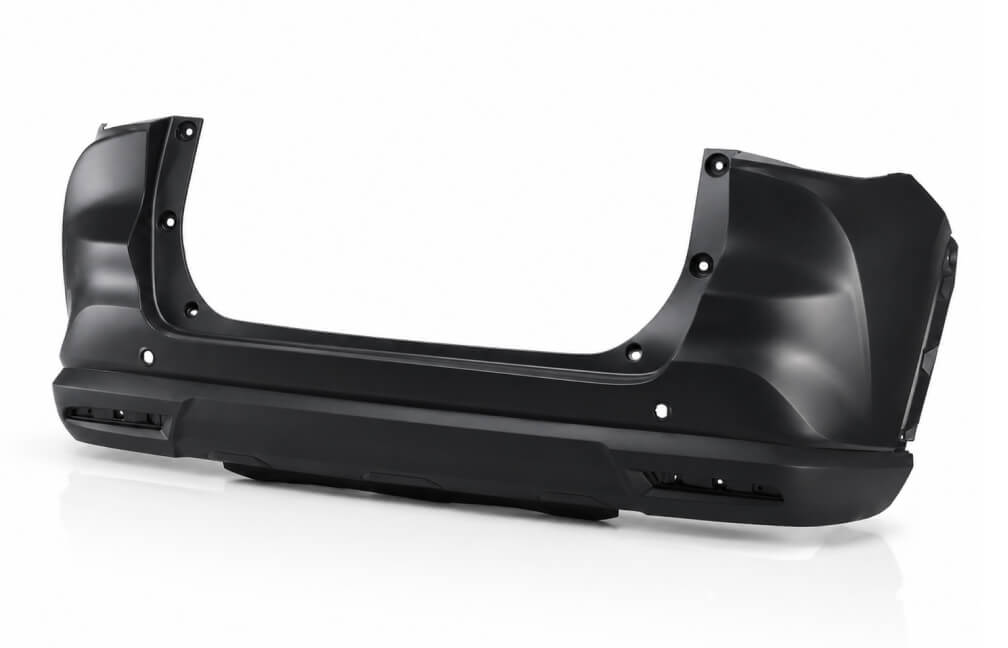
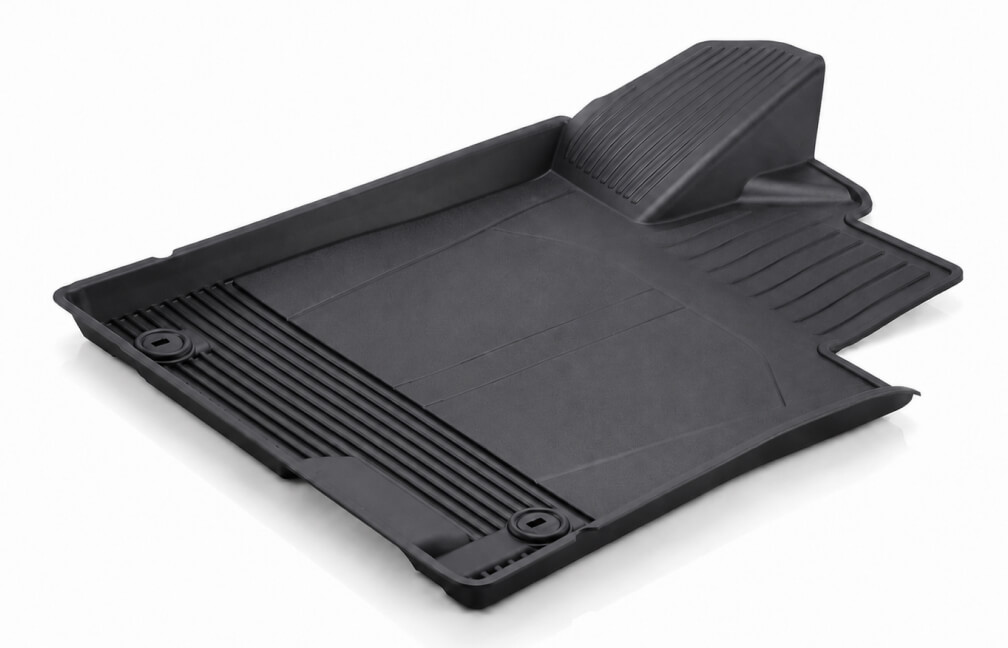
AMP molds large automotive plastic components such as bumpers, floor mats, grilles and seat outer panels at our plant in Tainan, southern Taiwan. We run 52 presses from 30 to 3,200 tons, making finished parts from 1 gram to 25 kilograms in a single shot. In this article we explain how to estimate the press tonnage your part needs, what tends to go wrong on large parts, and what the molding plant needs to have in place for large parts.
Mold makers estimate clamp tonnage from the projected area of the part and runner, multiplied by approximately 0.3 to 0.6 tonnes per square centimeter (2 to 4 US tons per square inch) for the resin. Bumpers, floor mats and seat outer panels usually need presses above 1,300 tons, so we will confirm the press requirements from your 3D file before we provide a quotation for the tooling.
How to calculate injection molding press tonnage
Tonnage is estimated from the projected area of the part and runner, so the weight of the part has little to do with it. The projected area is the shape you see looking straight down the direction the plastic is injected, so a floor mat has a great deal of it and not much resin.
The usual calculation is the projected area in square centimeters or square inches, multiplied by a pressure figure for the resin and the wall section. Suhas Kulkarni sets out a worked example in Plastics Technology (November 2023) in which a four-cavity mold with a total projected area of 28 square inches comes out at 112 tons. That gives you an idea of how rapidly the tonnage requirement climbs once a part reaches bumper dimensions.
Why the calculation is only a starting point
Kulkarni is clear that projected area on its own isn’t a reliable basis for tonnage. Wall thickness, gating, flow length and side actions all have an impact, and on a large part they can move it a lot. He also notes that sequential valve gating, where the gates open one after another, can let a large part run on a smaller press than its projected area would suggest. If you send us the 3D file, we’ll confirm the press and cavity layout together rather than just quoting from the drawing.
The table below shows where common automotive parts tend to fall, although geometry and resin can move a part up or down a class.
Our Thailand plant at Samut Prakan runs 22 machines from 65 to 1,300 tons for parts up to about 4 kilograms. It can serve as a second source for parts in the upper rows of the table, while the structural parts in the bottom row run in Taiwan.
Common challenges with large automotive plastic parts
Large parts often don’t fail in the same ways as small ones, and the main reason is often the distance the plastic has to travel. Molten plastic enters the mold through openings called gates. In a bumper more than a meter wide, the plastic from each gate travels a long way before it meets the plastic coming from the next one, and it cools a little as it goes. Problems that start on that journey tend to show on the finished surface.
On a large part, you may see weld lines, the faint marks left where two streams of plastic meet. Small amounts of shrinkage, which go unnoticed on a connector, can add up to a visible bow across a panel. Thick sections can sink as they cool, leaving shallow dents in the surface. The mold also needs more vents to let trapped air escape, since vents that are enough for a small part won’t clear a large one.
Most of this can be settled before any steel is cut, which is why we carry out a DFM review on every project. Gate positions, wall transitions and the points where flow fronts will meet are far cheaper to change on a drawing than on a trial shot.
Thick sections and warpage
Where a part has heavy sections and warpage is a concern, supercritical foam injection molding may be worth considering. The microcellular structure reduces part weight, sink marks and warpage, although how much it achieves depends on the geometry and the resin.
Glass fiber-reinforced resins
Many structural automotive parts are glass fiber-reinforced, and it’s worth stating the resin at the request for quotation (RFQ) stage. PA-GF, PBT-GF, PC-GF and PPS-GF are abrasive, so we run them on machines fitted with hardened screws and barrels to manage the wear.
Building and handling large injection molds
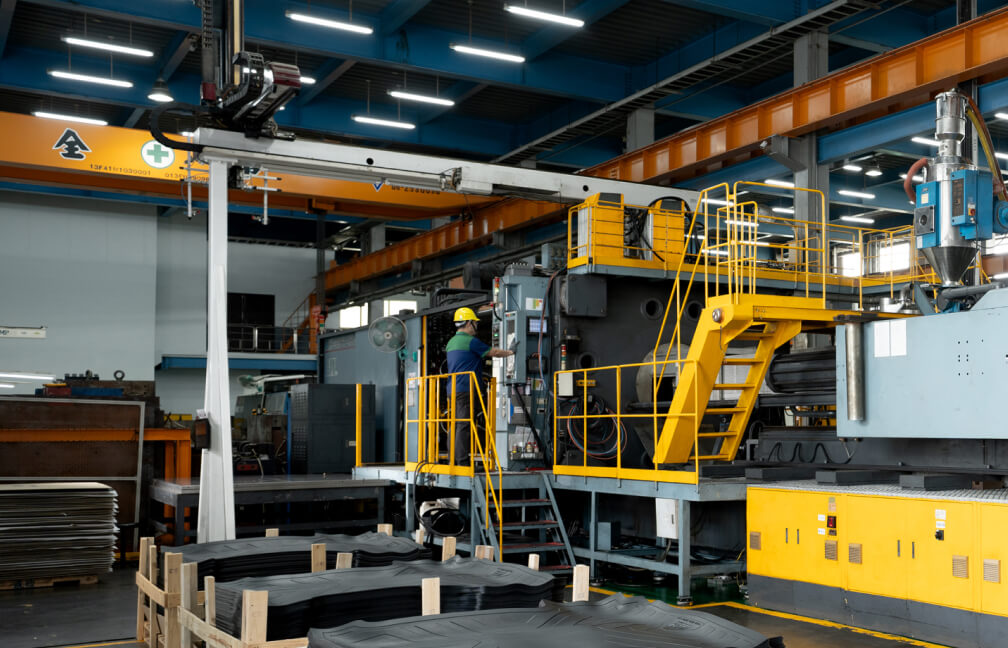
On large-part projects, building and handling the mold often causes more difficulty than finding a press. One of the molds running in our Tainan plant weighs 1,985 kilograms. A tool of that size needs crane capacity, somewhere to store it, a bench large enough to open it on, and toolmakers who have stripped down a mold that heavy before.
We machine molds in our own facility on eight CNC machining centers, three of them five-axis. Components are checked on a Mitutoyo CMM with a 900 by 1,600 by 800 mm measuring range before assembly, and we capture full-surface geometry with GOM ATOS 3D scanning down to 1 micron.
Conformal cooling for thick sections
Where a thick section needs cooling that drilled lines can’t reach, we print inserts by selective laser melting with conformal cooling channels that follow the shape of the part. We use these inserts to reduce cosmetic defects in high-heat areas, and on a large part, where cooling usually sets the cycle time, they can also help to shorten the cycle.
Mold corrections after the first trial
A large tool rarely runs perfectly from the first trial, so what matters is how quickly each correction can be made. For tools we’ve built ourselves, our machining floor and our presses are under one roof, so a dimensional correction can often go from the trial report to the machine and back onto the press without the tool leaving our site.
What a large automotive part needs from the mold maker
Beyond the press and the mold, a large part depends on three things at the plant, and we have each of them in Tainan.
Inspection of large cosmetic surfaces
A large panel is harder to inspect by eye because there is so much more surface to cover. We run automated CCD inspection at the press on selected lines, which catches surface defects such as sink marks and short shots before parts reach secondary operations, and our final inspection works to a defined scope of fourteen appearance defects. For a Class A exterior panel, we would suggest agreeing the cosmetic zones, the limit samples, and the lighting and viewing conditions at part approval.
Documentation for automotive part approval
Both our Taiwan and Thailand plants are certified to IATF 16949. This means that for automotive part approval we provide inspection reports, material certifications, process capability (Cpk) data and statistical process control (SPC) records, and we can support a full Production Part Approval Process (PPAP) submission where your customer requires one. All of this sits within the three-stage inspection process we run on every order.
Process stability over long runs
We run 24 hours a day in Taiwan, with parameter monitoring across each run that includes live Cpk tracking and alerts. Robotic arms remove parts at the press, as described on our smart manufacturing page. On a part where a single scrapped shot is 25 kilograms of resin, a drifting process wastes material quickly, so steady monitoring tends to matter more on large parts than on small ones.
If you’re also weighing where to place the work, our article on duty rates for Taiwan and China automotive parts sets out the September 2026 rates. Otherwise, if you send us the part drawing, the annual volume and the resin through our contact page, we’ll come back to you with the press, the cavity count and a tooling lead time.
Frequently asked questions
Take the projected area of the part and runner in the direction of injection, then multiply it by a tons per square inch figure suited to the resin, usually somewhere between 2 and 4. The result is a starting point, since wall thickness, gating and flow length all move it. AMP confirms the press and the cavity layout from your 3D file before quoting.
A large part can sometimes run on a smaller press than its projected area suggests, most often where sequential valve gating opens the gates in turn and keeps the plastic from cooling before the cavity fills. Whether that applies depends on the part and the hot runner design. AMP reviews gate positions at the DFM stage, so the question can usually be settled before the press is fixed.
For a Class A panel, the cosmetic zones, the limit samples and the lighting and viewing conditions for inspection are best agreed at part approval, so that you and AMP judge the surface in the same way. AMP's final inspection works to a defined scope of fourteen appearance defects, and selected lines add automated CCD inspection at the press.
On a large part with thick sections, cooling usually takes up the longest share of the cycle and has a strong effect on warpage. Drilled cooling lines can't always reach the hottest areas, so AMP prints mold inserts by selective laser melting with conformal cooling channels that follow the part. These inserts reduce cosmetic defects in high-heat areas and can shorten the cycle.