
Supercritical Foam Injection Molding
Last updated
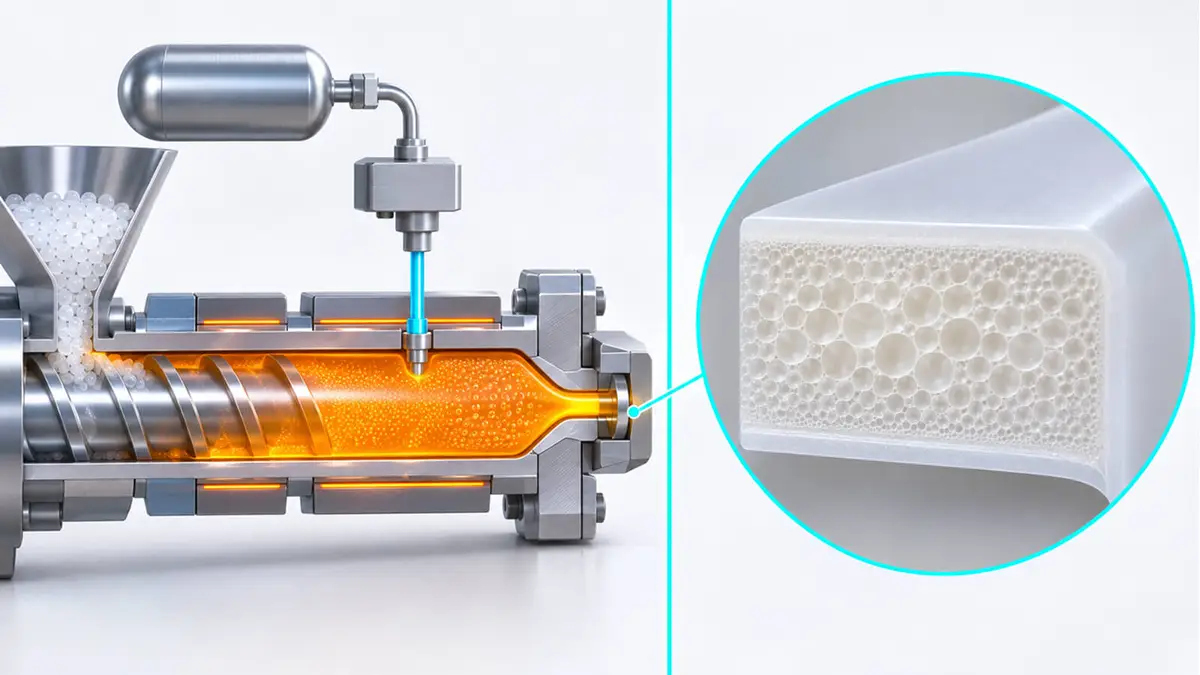
Definition of Supercritical Foam Injection Molding
Supercritical foam injection molding is a microcellular foaming process in which nitrogen or carbon dioxide, held in a supercritical state, is dissolved into the molten plastic so that the molded part forms with a solid outer skin and a core of small closed cells. A supercritical fluid is a gas held above its critical temperature and pressure, where it behaves partly as a gas and partly as a liquid and mixes evenly into the melt. The best-known commercial version is MuCell, a registered trade name of Trexel. The process uses a standard injection molding machine fitted with a gas dosing unit, a modified screw and barrel, and a shut-off nozzle that keeps the melt under pressure until injection. When the gas-laden melt enters the mold, the pressure drops and the dissolved gas forms cells, usually under 100 microns across. The result is usually specified as a percentage reduction in part weight or density against a solid part, and checked by weighing parts and examining cut sections under a microscope.
Why This Matters for Your Business
The foaming gas does the job that holding pressure does in conventional molding, so the process runs with lower cavity pressure, and that has several commercial effects. The part can often be molded on a smaller press with lower clamp tonnage, and the cycle is usually shorter because there is no long holding phase, which together reduce the machine-hour cost in the piece price. Material use falls in line with the weight reduction, typically 5 to 15 percent, which becomes significant on high-volume programs and on large parts.
Against these savings, the molder pays for the gas dosing equipment and machine modifications, and the MuCell process carries license fees, so a quote may show a higher machine rate even where the part price falls. Surface appearance is the main limitation, since escaping gas leaves swirl marks and silver streaks on the surface, so visible cosmetic parts usually need painting, a textured surface or extra tool technology such as rapid heating and cooling of the mold. The foamed core also lowers tensile and impact strength somewhat, so parts with safety or load requirements need testing against the reduced values.
When you compare molders in Taiwan or Southeast Asia, confirm that the press quoted for your part is fitted for the process, since the equipment sits on specific machines and is not a general shop capability. You should also ask for trial data on a similar part before you commit the tooling to the process.