
Plastic Material Selection
Last updated
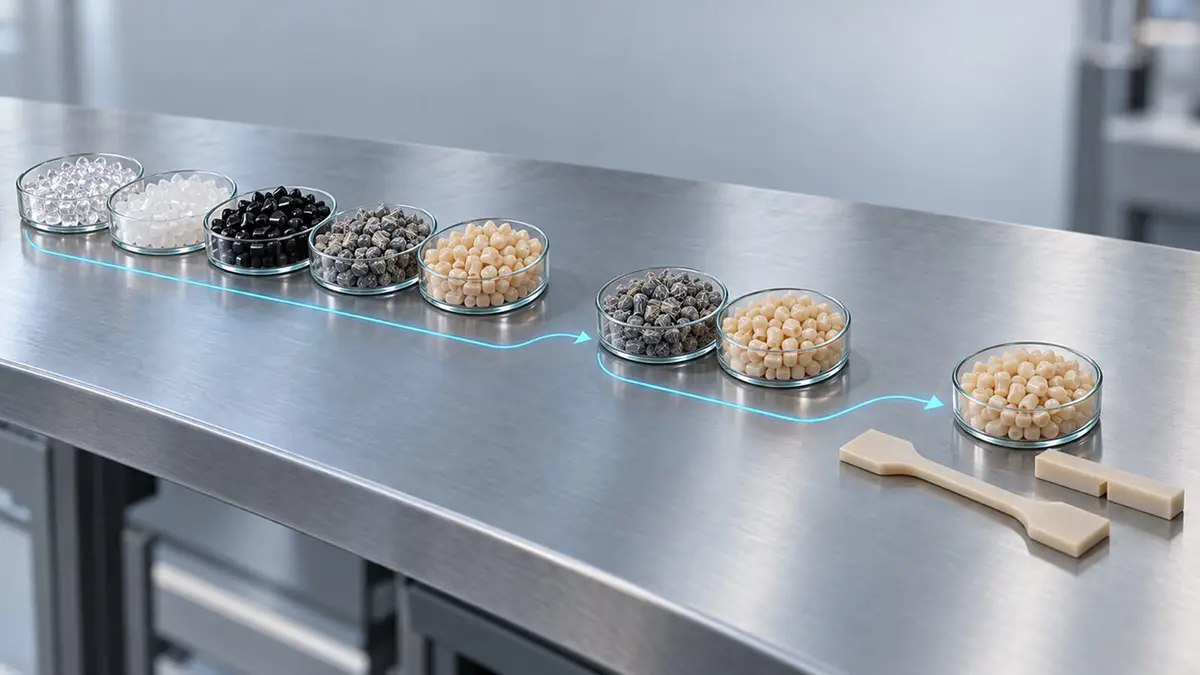
Definition of Plastic Material Selection
Plastic material selection is the process of choosing the specific resin grade for a molded part, by matching its mechanical, thermal, chemical, appearance and regulatory properties to what the part must do in use. It takes place early in product development, before mold design starts, because the chosen material sets the shrinkage allowance cut into the mold cavity, the gate design and the processing conditions on the press. Selection normally narrows in stages: from a material family, such as polycarbonate (PC) or polyamide (PA), to a modified type, such as PA66 with 30% glass fiber, and finally to one manufacturer's named grade. Candidates are compared on datasheet values measured to standard test methods, including tensile strength under ISO 527, notched impact strength under ISO 180 or ISO 179, heat deflection temperature under ISO 75 and melt flow rate under ISO 1133. Flammability is usually expressed as a rating under the UL 94 standard, such as HB or V-0. The outcome is a material specification, usually written on the part drawing.
Why This Matters for Your Business
The material choice fixes a large share of the piece price, the tooling design and the quality risk before a single part is molded. Resin is often the largest single cost in a medium or large part, so specifying an engineering grade where a commodity grade such as polypropylene (PP) would do adds cost to every part for the life of the program. Under-specifying tends to cost more in the end, since a part that cracks, creeps or discolors in the field leads to returns, redesign and often a new tool.
Changing the material after the mold is built is also expensive, because each resin shrinks by a different amount as it cools, typically 0.4 to 0.7 percent for acrylonitrile butadiene styrene (ABS) and 1.5 to 2.5 percent for PP. A switch between them often means re-cutting or replacing the cavity and repeating the sample approval.
Grade substitution causes a good deal of trouble in export supply chains, where a supplier may propose an "equivalent" grade from another producer to save cost or time, and the substitute then molds differently or fails a test the original passed. You should require written approval for any change of grade. Taiwan molders can usually buy standard grades locally from producers such as Chi Mei and Formosa Plastics, while specialty grades are often imported and may carry longer lead times and minimum order quantities, so it is worth asking about availability when you request quotes.