
Mold Life
Last updated
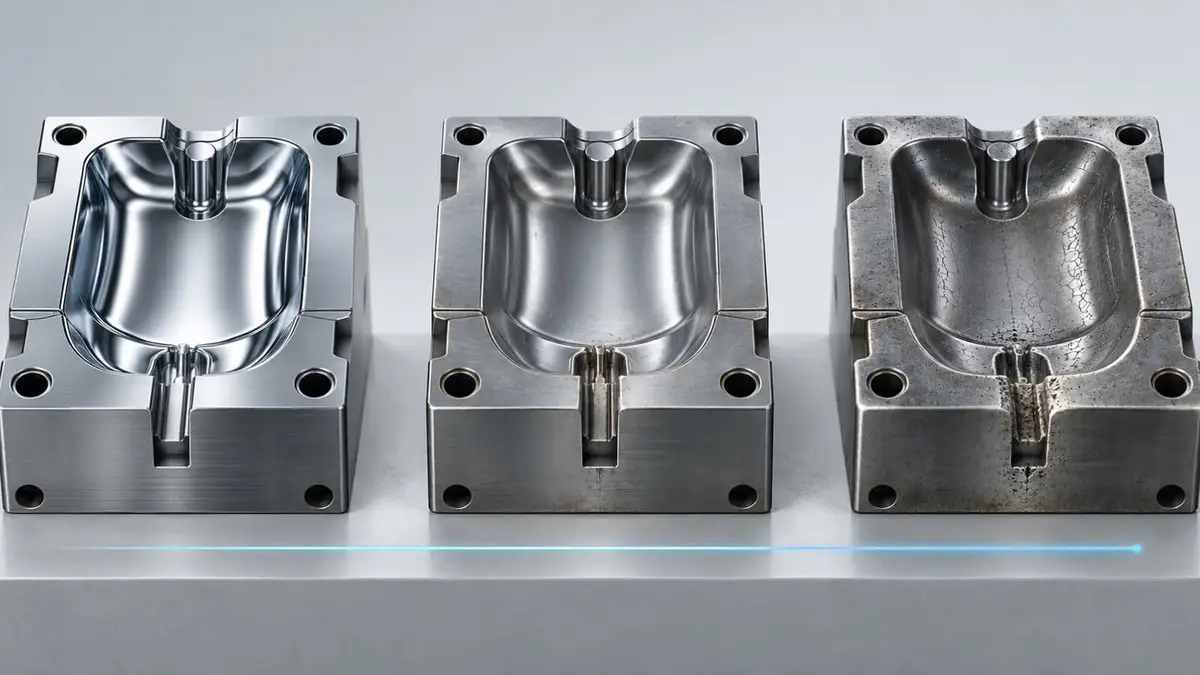
Definition of Mold Life
Mold life is the number of production shots an injection mold can deliver before wear, damage or dimensional drift force a rebuild or a replacement. Steel hardness, part geometry, the resin being molded and the standard of maintenance are what set the figure.
A soft aluminum or pre-hardened prototype tool may be rated for a few thousand shots, a P20 production tool for several hundred thousand, and a fully hardened H13 tool for a million or more, which is roughly how the widely used SPI mold classes are arranged. Glass-filled and flame-retardant resins are abrasive and shorten life considerably, as do sharp gate areas and thin steel conditions.
Buyers sourcing tooling from Taiwan and Southeast Asia should ask for the rated shot count in writing, together with the steel specification behind it, since a quotation that omits both is not yet a quotation for a production tool. Rated mold life is a maintenance figure rather than a fixed one, and tools cleaned and inspected on schedule routinely outlast it.
Why Mold Life Matters for Your Business
Every tool you buy is an asset with a finite output, and the rated life determines how its cost spreads across the parts you sell. A tool rated for 100,000 shots carries four times the tooling cost per part of one rated for a million, which is why the cheapest mold on a quotation sheet is not always the cheapest part.
Supply continuity is the second concern, and usually the more expensive of the two. A mold that reaches the end of its life unexpectedly takes your line down for however many weeks a replacement takes, and that gap normally costs a good deal more than the tool did.
Rated life also gives you a reasonable basis for holding a supplier to account. Where the steel grade and shot count appear on the purchase order, premature failure becomes a warranty discussion rather than an argument about what anybody assumed.