

AMP monitors the injection process while it runs, not only the parts it produces.
Industrial data gateways on our production floor connect directly to our all-electric injection machines and their PLC controllers. Barrel temperature, injection pressure, holding time, clamping force, and screw position are read continuously through every cycle and compared against the process window validated for your part during mold trials. This monitoring layer sits at the center of our smart manufacturing capability.
Because the connection is to the controller rather than to a separate sensor package, the data is the machine’s own operating record. Short excursions that a periodic manual check would not see are captured and retained.
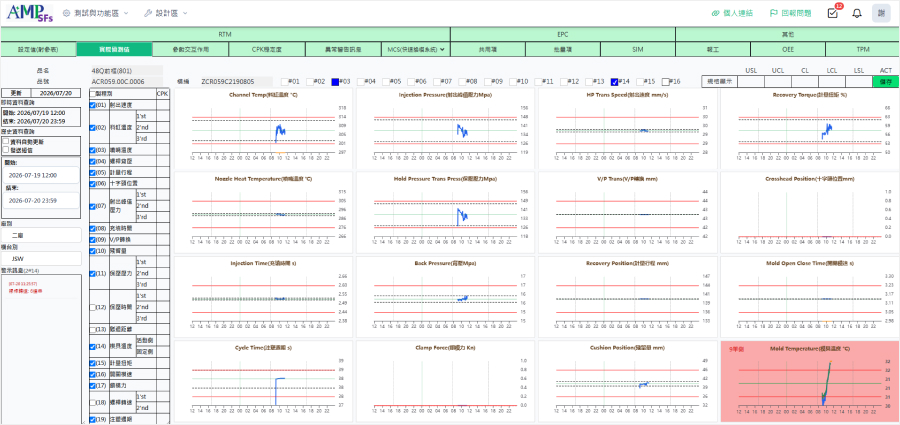
Alerts Route to a Named Responsible Engineer
When a monitored parameter moves outside your part’s validated window, our system raises a tiered alert. Notifications reach the floor and the responsible engineer directly, including by mobile message, so response begins while the machine is still running.
The alert names an owner. It does not sit in a queue waiting for a supervisor walk-through or a shift handover, which is when process deviations most often go unaddressed on a 24-hour operation.
Both our Taiwan and Thailand facilities run continuous production under this same monitoring framework.
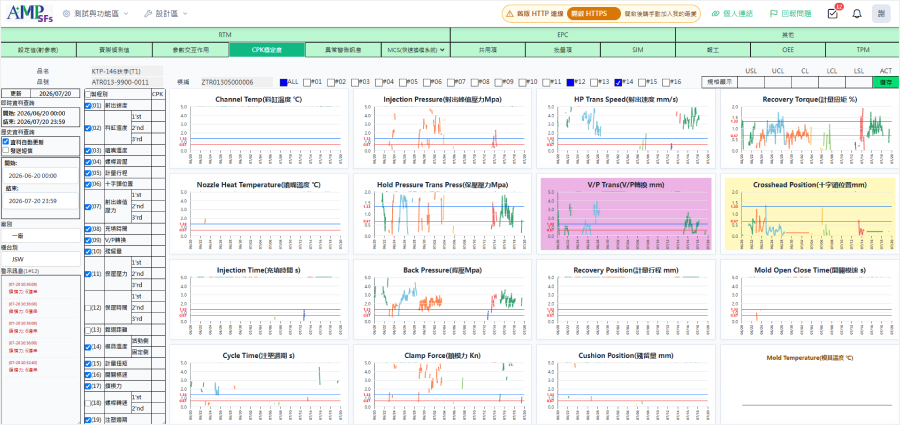
CPK is Tracked Live, Not Reported Periodically
AMP calculates process capability continuously from live parameter and characteristic data across the run, rather than treating CPK as a study performed at a fixed point and filed.
The system raises an alert when CPK falls below 1.0, and also when capability shows a downward trend while still above threshold. The trend case matters: a cell moving from capable to marginal is still producing conforming parts, and correcting it at that stage costs a parameter adjustment rather than a sorted lot.
When a cell is flagged, our system retrieves the parameter settings from the last three runs of the same mold in the same material and presents them to the technician. Adjustment is made against your program’s own validated production history rather than from judgment alone.
SPC Rules Catch Drift Inside Specification
Alongside threshold monitoring, standard SPC rules run against the live data stream to identify non-random patterns.
These rules detect conditions where every individual reading remains within specification but the pattern indicates a process losing control: consecutive points trending in one direction, extended runs on one side of the mean, or unusual clustering. A run producing good parts on a steadily rising trend is flagged before it produces a bad one.
For tight-tolerance and cosmetic components, this is the detection layer that prevents avoidable scrap on long runs.
Every Alert Closes Through a Corrective Action Record
Detection is tied to a documented response.
Each alert opens a corrective action record that stays open until the cause is identified, the correction applied, and the correction verified against subsequent production data. Records route by cause. Deviations traced to process settings go to our process improvement history for that program. Deviations traced to machine condition go to preventive maintenance.
Separating the two routes means a recurring fault is corrected at its actual source rather than being repeatedly compensated for at the press.
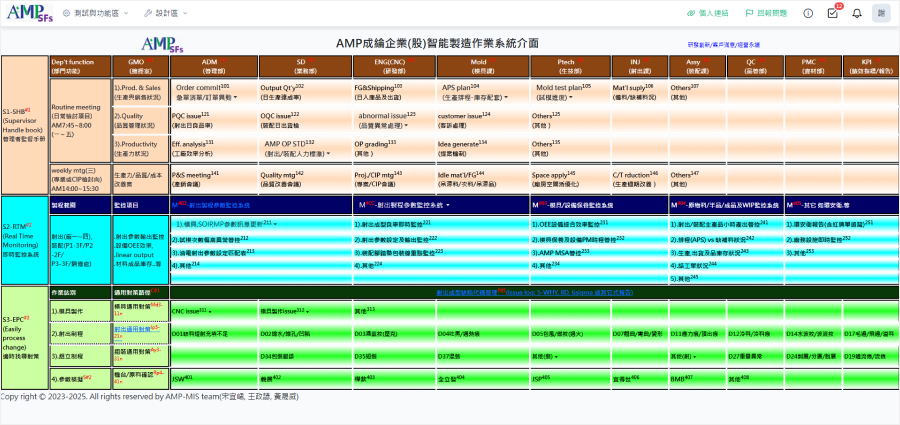
Monitoring Works Alongside Inspection and Automation
Parameter monitoring addresses process-driven variation. It does not replace inspection, and AMP does not run it in isolation.
CCD cameras at selected molding cells check surface and dimensional characteristics at the press, catching defects before parts move to secondary operations. Servo-driven electric presses provide the shot-to-shot repeatability that makes monitoring at this resolution meaningful, and robotic arms remove parts at the press to reduce manual handling and protect cosmetic surfaces.
Documentation is a By-Product, Not a Separate Exercise
Because every deviation, correction, and capability record is tied to a specific run, tool, and drawing revision through our PLM and ERP systems, the traceability an audit requires already exists.
Customers on IATF 16949 automotive programs receive first article documentation, process capability studies, and part submission records as standard. Non-automotive customers can request capability reports, deviation and corrective action records, and production traceability on a program-by-program basis.
FAQ
Barrel temperature, injection pressure, holding time, clamping force, and screw position, read continuously from the machine's PLC controller throughout the run and compared against the process window validated for your part during mold trials.
When CPK falls below 1.0, and also when capability trends downward while still above that threshold. The system additionally retrieves parameter settings from the last three runs of the same mold in the same material as a validated reference for adjustment.
Monitoring checks whether a parameter sits inside its validated window. SPC analyzes the same data for non-random patterns, including trends that remain within specification but indicate the process is losing control.
No. Monitoring addresses process-driven variation. Tooling damage, material contamination, and handling defects still require inspection, which is why CCD inspection at the press runs alongside parameter monitoring.
Both our Taiwan and Thailand facilities run 24-hour production under the same monitoring and quality framework.
See how process monitoring runs across our facilities on our Smart Manufacturing page, or contact our engineering team to discuss your program.